India's Telecom War: Can Jio and Airtel Survive Starlink's Entry?

- Created Jan 27 2026
- / 498 Read
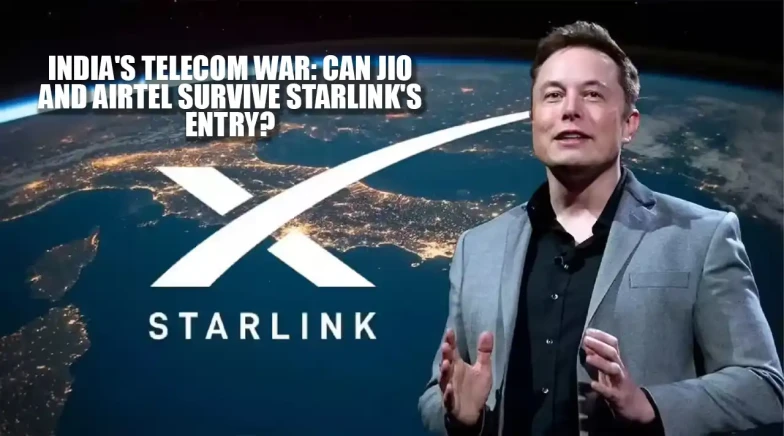
India's Telecom War: Can Jio and Airtel Survive Starlink's Entry?

-By Jaya Pathak
The entry of Starlink in India can only be analyzed as a new layer of access, rather than an outright device that replaces 4G/5G networks- and that is the difference why Jio and Airtel cannot actually be wiped out, even in case of change of the competitive map. The short-term struggle will also not occur in consumer SIM churn but in enterprise connectivity, coverage gaps in the rural areas, and regulatory economics of satellite spectrum.
Starlink has already received the Department of Telecommunications (DoT) GMPCS license which is one of the main requirements to provide services of satellite communication in India. It is also reported that Starlink has been licensed with a VSAT license and in-flight and maritime connectivity, yet its rollout can still be influenced by security review and demonstrations to prove their compliance. Correspondingly to the industry reporting, there has been an industry reporting of a final approval layer comprising of the IN-SPACe documentation and authorisation, indicating that the operational green light is not solely telecom-facing.
This sequencing is important in that it defines the competitiveness in the first year. Slow approvals, security demonstrations and ground infrastructure will result in early Starlink impact being structured around the locations where willingness to pay is most intense and where the urgency to have been deployed is greatest, enterprises, remote locations and institutional connectivity than it is at mass-market urban broadband.
Jio and Airtel do not rest
The least recognized fact is that the incumbents in India are already developing the satellite options, and some of them have the paperwork head start. Reports that the OneWeb Bharti backed and the Jio SES joint venture (Jio Satellite Communications) have been licensed to provide satellite services in India. Business reporting has explained how OneWeb (licensed prior) and Jio Satellite (licensed subsequently) have been going through security-clearance and demonstration, buttressed by the government extending the timelines of such demonstrations.
Bharti Airtel has publicly been associated with a partnership approach to Starlink on the go to market side as a method to tap into the increased LEO constellation capacity of Starlink as Airtel also maintains an exposure to Eutelsat OneWeb by the current schemes. The same report outlines possible distribution and enterprise movement Starlink equipment on Airtel retailer outlets, Starlink services sold through Airtel to business clients, and neighborhood and institution connectivity packages.
Jio, in the meantime, has made JioSpaceFiber a satellite-based broadband service and as a partner with SES, with a claim to MEO with SES O3b and O3b mPOWER services to provide "gigafibre-like" services in space. That is, Jio has not adopted the strategy of competing against satellites using towers, but instead, adding satellite coverage into its connector stack, particularly to cover reach and backhaul.
What is really threatening by Starlink
The smartphone user in Mumbai comparing prepaid packs is not the best wedge that Starlink can use in India. This high-cost to serve customer on the land is the wedge: mines, ports, highways, schools in the country, health center, and industrial corridors and disaster prone areas which care more about the up time than the headline Mbps.
This is the reason why Airtel described the positioning it has reported, which combines both Starlink and OneWeb as a means of closing coverage gaps and creating a broader satellite broadband catalogue, sounds more like a hedged portfolio approach than a defensive response. It is also the reason why the regulatory argument about the pricing and assignment of satellite spectrum becomes the centre stage: to the extent that satellite spectrum is priced to allow aggressive expansion, satcom becomes the competitive alternative to fixed wireless in sparsely-populated geographies; to the extent that satellite spectrum is priced more conservatively, it will continue to be a premium niche.
Another overture: the India narrative of Starlink is not over merely being in competition with telcos: it is a narrative of balancing with them. Airtel can report its partnership strategy, which implies that incumbents can seek to intermediate Starlink, or transform a threat into a channel product instead of letting it transpire as a brand-new scale retail competitor.
The question that is really a strategy question is the survival question: "Can Jio and Airtel survive?" is calmative psychologically, but tactical strangely unfinished. The more specific question is: would they be able to ensure that satellite broadband is not turned into a parallel network with a marginalizing effect that is bleeding enterprise ARPU without leaving them with the most price-sensitive consumer traffic?
The response that Airtel seems to be offering is the partnership-based optionality: co-distribute Starlink where it is needed, and retain a OneWeb channel to other niches and architectures. Jio seems to have found a solution in platform control: incorporate satellite through the SES-enabling solution into its broadband and backhaul story, increasing its reach without losing the customer relationship at the heart of the Jio ecosystem.
In that regard, the entry of Starlink may even cement the incumbents provided that they employ it to lower the costs of remote demand-service, particularly where terrestrial buildout is slow, competitive, and economically unfeasible. The threat, rather, is implementation: channel war, service responsibility, complexity in installation, and ownership of the customer experience where the network is not completely under the control of the telco.
The possible outcome of this telecom war:
1) Enterprise-first: Enterprise Enterprise: Sun satcom is marketed directly to enterprise clients and customers, usually through enterprise divisions of telcos, and Jio/OneWeb are filling their own rails, with Starlink taking partners.
2) Pricing inspired by regulations: spectrum pricing and authorisation procedures will decide whether satcom sells to mid-market households or remain concentrated in the premium and remote parts of the market.
3) Hybrid networks gain validation: Jio and Airtel are moving more and more towards terrestrial + satellite as a product of one continuity and not two distinct products with the satellite taking the hit of the map.
FAQs
1) Is Starlink critically registered to run in India?
Starlink has been granted the GMPCS licence by the DoT in India, one of the main regulatory conditions, and other licences are also reported, including VSAT, in-flight/maritime connectivity, but there are still more compliance and security measures that can influence the date of launch.
2) Does Airtel and Jio have already satellite broadband?
It has been reported that the government has licensed OneWeb, which is supported by Bharti and the Jio-SES known as the Jio Satellite Communications to provide satcom services in India.
3) What is meant by some reports concerning Starlink rollout in India as being delayed?
Coverage has cited security scrutiny, compliance demonstrations, and outstanding authorisation (such as IN-SPACe documentation) as reasons that may increase timelines even after GMPCS licence has been issued.
4) Why would Airtel partner with Starlink instead of only backing OneWeb?
One report frames Airtel’s strategy as gaining access to Starlink’s larger LEO constellation capacity while still having OneWeb exposure, allowing Airtel to market a broader satellite catalogue and address different coverage gaps and use cases.
5) What is the satellite strategy of Jio?
Jio has been advertising JioSpaceFiber and underlining its collaboration with SES, and how SES has used its O3b and O3b mPOWER systems to provide service at speeds in the gigabit range and also increase the range of connectivity.
Explore: Moderntimes24.com
For Add Product Review,You Need To Login First